Free printableAges 3-4, Pre-KAddition
Addition Within 5 Quick Sheet
One free page: count the dots, write the sum — addition within 5.
Step 1 of 3 on the addition path
Print & download
Addition Within 5 Quick Sheet (1 page)
Free to print and use at home or in the classroom, as many times as you like.
How to use this
What it builds
Within 5 is the very first addition a child does without adult help, because every total here is small enough to subitize — glance at a cluster of two or three dots and know the count without touching each one. That matters: research on early number sense shows children move from counting-all to instant recognition for small quantities well before they can do the same for bigger ones, and pages that stay under five let that instant-recognition skill do the work instead of forcing slow one-by-one counting on totals too small to need it. Eight pairs cover every combination from 1+1 to 1+4, so a child meets both 'doubles' (2+2) and 'near-doubles' (1+2) in one sitting — the two patterns most kindergarten curricula introduce first because they are the easiest to picture with fingers or dots. Three of the eight pairs (1+2, 1+3, and their partners 2+1, 3+1) use the same two numbers in a different order, which is usually the first time a child notices that order doesn't matter — the earliest possible look at commutativity, long before the word means anything to them. Writing the total in a box, rather than circling or tracing it, is a small but real step toward the number sentences (2+3=5) they will see written out in first grade. Keeping every total at five or under also means a child never has to abandon the strategy that's working for them mid-page — there's no row that suddenly demands careful counting when the previous rows were solved at a glance, which is exactly the kind of jump that makes an early worksheet feel harder than it needs to be.
Ready when
A child who can count a group of up to five objects and recognize the numerals 1–5 is ready — they do not need to know what a plus sign means yet, since an adult reading the page aloud carries that part. If they still recount the same dot twice, this page is exactly the right difficulty; within-10 and make-ten are the next step, not this one. There's no fixed age this has to happen by — some children are ready at three, some closer to four and a half, and nothing on the page is timed either way.
How to run it
Print one copy on plain paper. Ask them to look at the left group first — for totals of three or fewer, encourage them to just 'see' the number rather than count it, and check if they can. Point to the right group, count together if needed, then ask for the total and let them write it in the box. Three to five minutes covers the page since the totals are small. This is the natural first free download for a parent typing 'kindergarten addition worksheets' who wants something before the within-10 level; keep it in a morning basket or hand it out on day one of a counting unit. No email needed — download, print, and start. Once every row feels easy, put the page away for a week and try it again cold — a child who solves it faster the second time has moved the facts from counting to recall, which is the actual goal, not just a completed worksheet.
Step 1 of 3 on this skill path
- 1Addition Within 5 Quick SheetAges 3-4, Pre-K
- 2Addition Within 10 Quick Sheet
- 3Make Ten Addition Quick Sheet
More like this
- Free
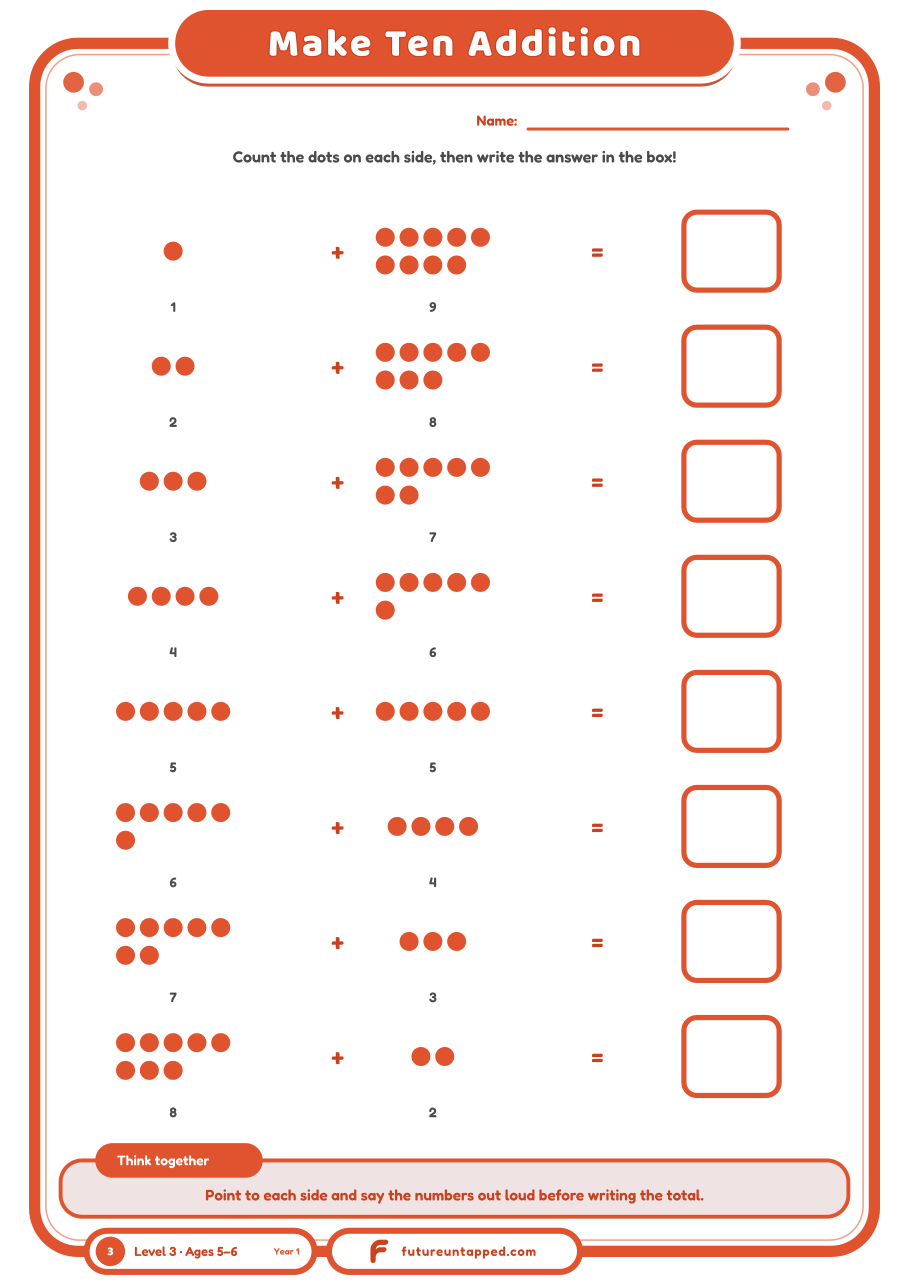
Make Ten Addition Quick Sheet
Ages 5-6, KAddition1 page, Letter and A4
- Free
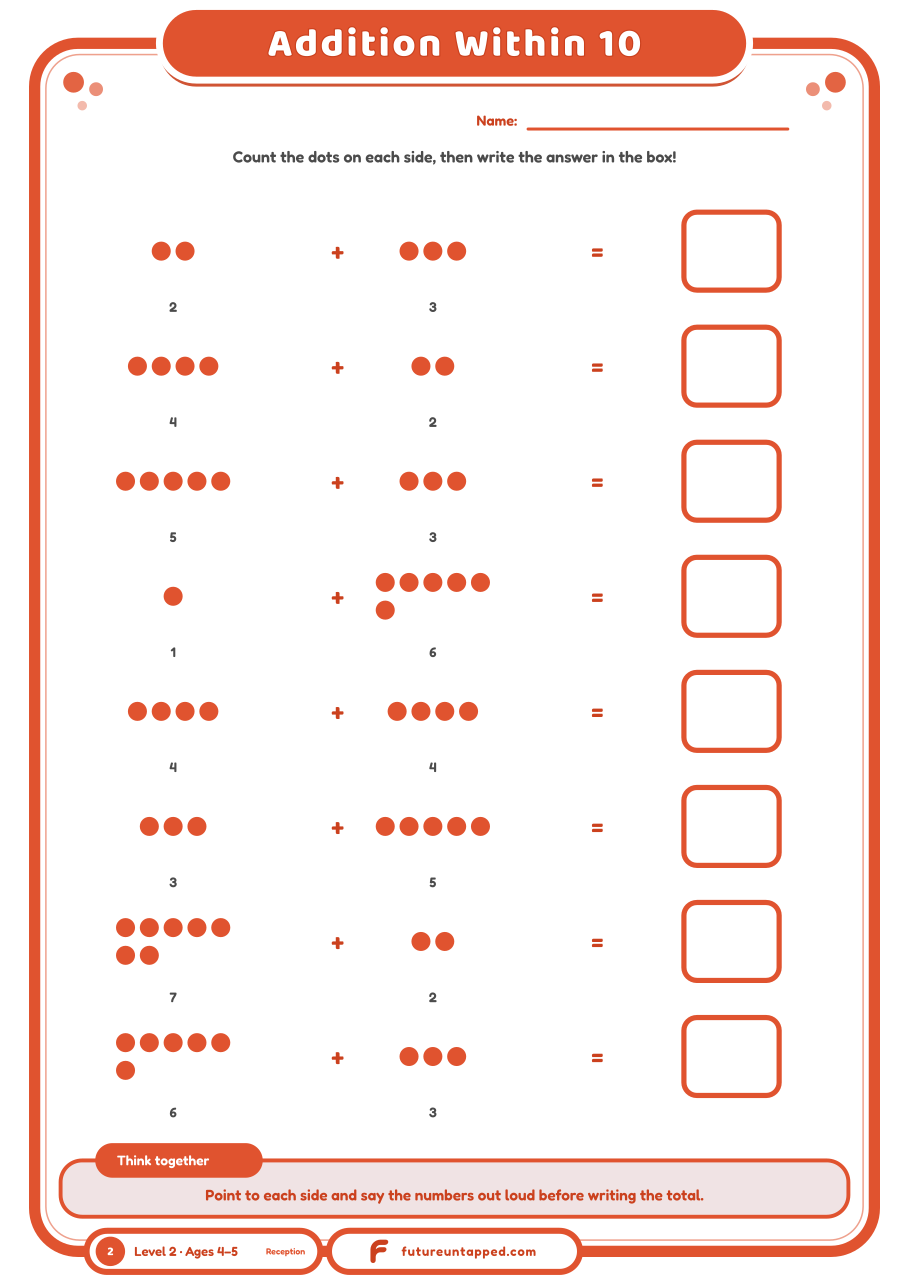
Addition Within 10 Quick Sheet
Ages 4-5, Pre-K/KAddition1 page, Letter and A4
- Free
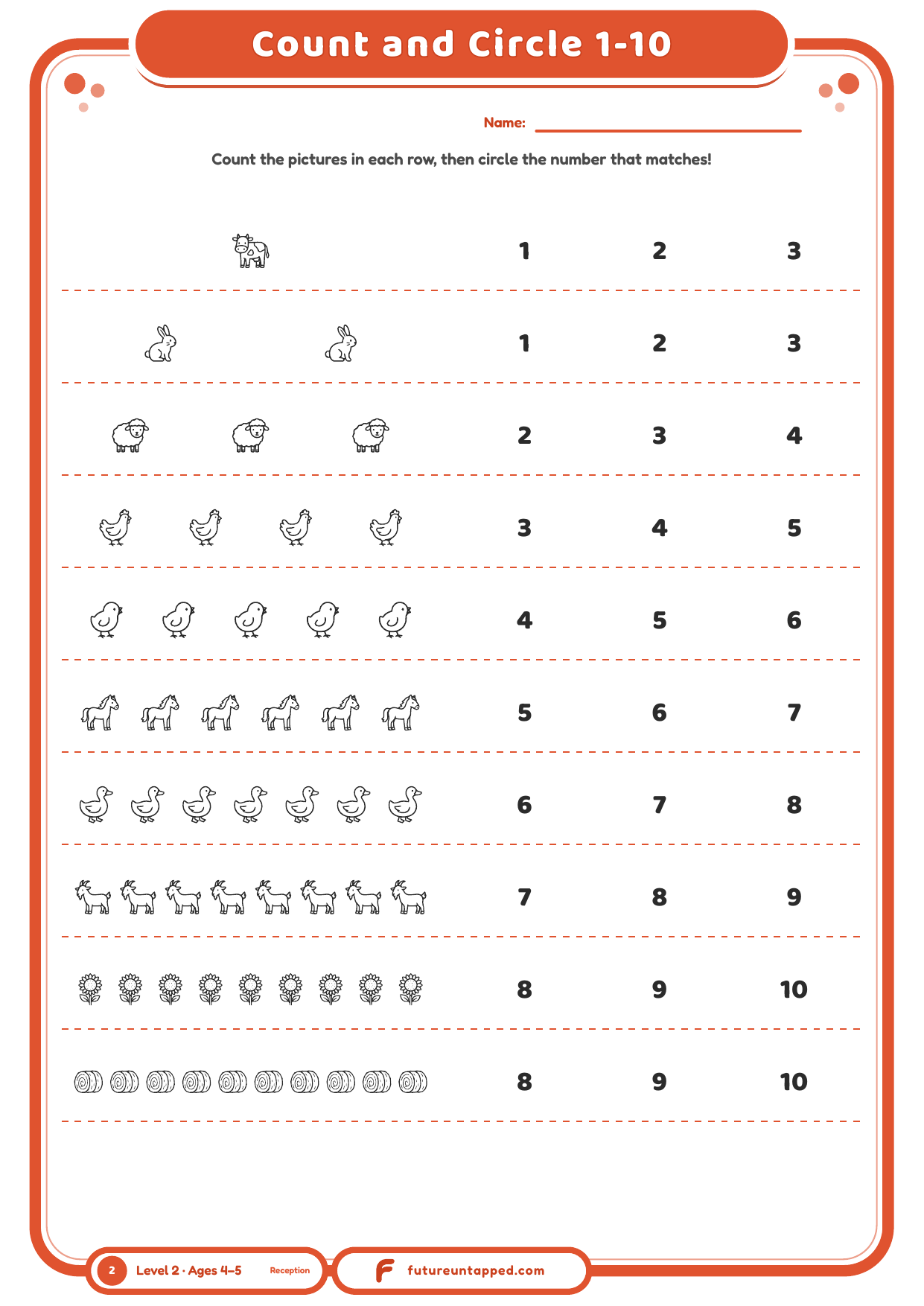
Count and Circle 1-10 Worksheet (Free Printable)
Ages 3-4, Pre-KCountingLetter and A4
- Free
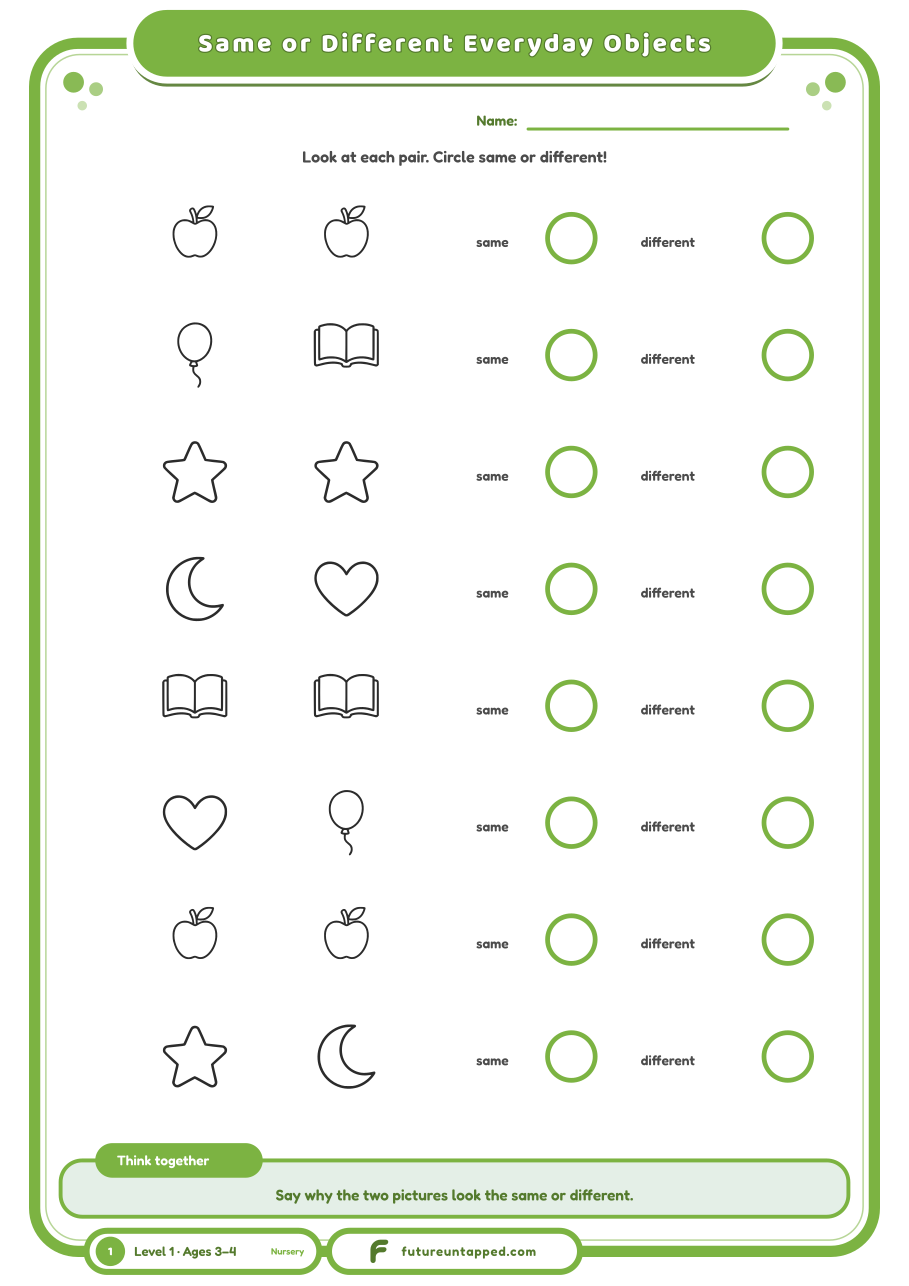
Same or Different Everyday Objects Quick Sheet
Ages 3-4, Pre-KMatchingDecor, 1 page, Letter and A4


